Books About Life After Work: UBI, Post-Scarcity and What Comes Next
A reading list on universal basic income, post-scarcity, and what people would actually do if work stopped being mandatory — with honest drawbacks and a real alternative to UBI.
A reading list on universal basic income, post-scarcity, and what people would actually do if work stopped being mandatory — with honest drawbacks and a real alternative to UBI.
The strongest books on AI and jobs, organized by the real questions: does automation destroy work on net, what happens to the displaced, who captures the gains, and what to do about it.
You finished Abundance and you want the next argument. Here are seven real, correctly-dated books on why wealthy societies fail to deliver what they promise — from Seeing Like a State to Why Nations Fail.
A ~15,000-word argument that American freedom is already mostly theoretical — and that cheap AI will either fix that or make it permanent. This is the page from the person who wrote it.
A superintelligent government runs the courts better than we ever did. Then one woman requests a jury — and to try her, the jury has to judge the machine.
Fiction about machines making legal and moral decisions about people — nine books, organized by the question each one asks: Can it be fair? Who audits it? What is lost?
Nine honestly-curated read-alikes for Bobiverse fans — the ones that actually nail Bob's dry, competent, first-person voice, plus who each one isn't for.
If you liked Infomocracy, QualityLand, or The Circle, here's the honest shelf: eight real, correctly attributed novels about societies that hand the decisions to the algorithm.
A verified, opinionated guide to the best fiction about artificial intelligence — every title real and correctly attributed, with an honest drawback for each.
If you finished Foundation and wanted more fiction about predicting and steering entire societies, here are eight real books — with honest drawbacks — organized around the one idea Asimov made unforgettable: psychohistory.
A curated list of parable and wisdom-story collections drawn from Zen, Sufi, Taoist, Jewish, and folk traditions — not religious instruction — sorted by the situation you're in.
An honest, technical comparison of local and private AI assistants in 2026 — OpenAGI, Ollama, LM Studio, Jan, GPT4All, and more. Runner vs. assistant
proactive AI agent
A proactive AI agent observes your context and surfaces work before you ask. Learn how it differs from reactive AI, why noise is the hard problem, and the
book recommendations
Seven short, blunt product books for people who loved The Mom Test — customer interviews, discovery, and behavior, with no filler.
product-psychology
The books that explain why users behave the way they do — not process, not frameworks. Kahneman, Ariely, Cialdini, Norman, and the rest, with a quote and an honest drawback for each.
books like the alchemist
Eight short, parable-shaped books that give you the same feeling as The Alchemist — a life lesson that arrives as a story, not a sermon.
product theory
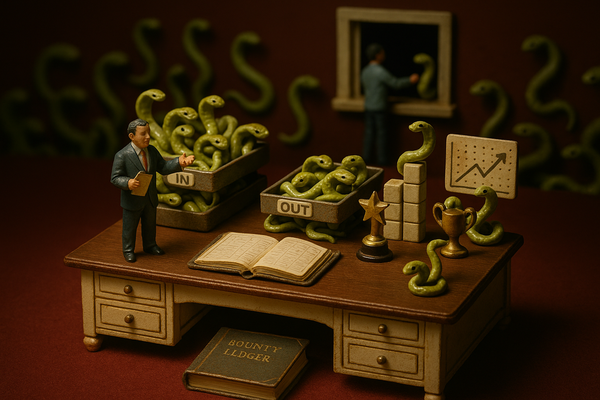
Every incentive creates a game. The Cobra Effect is what happens when it's not the game you wanted—and why your best-looking metric might be the one breeding snakes.

product theory
People value what they build far beyond its objective worth. The best products don't just get used — they get built on. Here's how to design for it.

wisdom
A distinguished professor watched a Zen master pour tea until it spilled across the floor. The lesson still lands: you can't fill a cup that's already full.

product theory
People don't stay in bad situations because they can't see better options. They stay because their brain protects the known from the threat of the unknown.

conways-law
The seams in your product are copies of the seams in your org chart. That's not a metaphor — it's Conway's Law, and it predicts what your app feels like to use.

words
Three old stories about choosing well: the crossroads, the strawberry on the cliff, and the woman carried across the mud. What they teach about the moment of decision.

mental models
Most product decisions go wrong for reasons that already have names. Here are 12 mental models — what each one is, a concrete product example, and when it quietly lies to you.

pricing
Everyone knows the $9.99 trick. Everyone still falls for it. Here's why the last digit of your price is a positioning decision, not a math one.