3 Wisdom Stories for When You Feel Stuck
Being stuck and going nowhere are not the same thing. Three old stories about the difference — and what to do when you can't see your own progress.
From Words: Fables, Parables, and Wisdom for Modern Life — 200+ wisdom stories, organized by the moment in life you'll need them.
Stuck rarely feels like a wall. It feels like a treadmill — motion without movement. You're doing the work, and nothing is changing.
The trap isn't the lack of progress. It's the story you tell yourself about the lack of progress: that you chose wrong, that you're not built for this, that it's time to quit. Sometimes that story is true. More often, it's just the shape of a stage you haven't finished yet.
Here are three old stories for when you can't tell the difference.
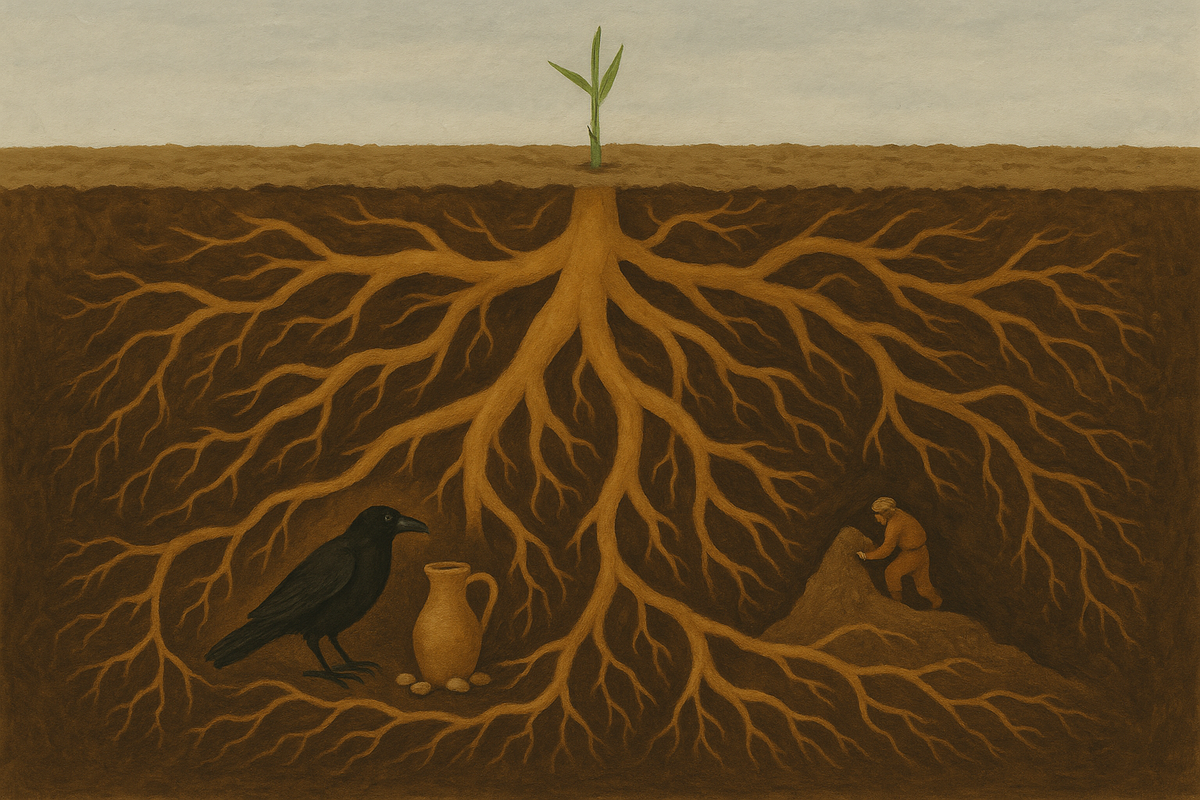
1. The Chinese Bamboo Tree — growth you can't see is still growth
A farmer plants a bamboo seed in spring. He waters it, weeds it, tends the soil. A year passes. Nothing breaks the surface.
The second year, still nothing. Neighbors start to wonder aloud whether the seed was dead, whether he should plant something useful instead. He keeps watering.
Third year. Fourth year. The patch of dirt looks exactly as it did the day he planted it. Some neighbors stop asking. Others just shake their heads as they pass.
In the fifth year, a green shoot appears. Then, over six weeks, the bamboo grows ninety feet tall.
People come from other villages to see it. "Ninety feet in six weeks — how?" The farmer smiles. "It didn't grow ninety feet in six weeks. It grew ninety feet in five years. You just couldn't see it. For five years it was building roots — a foundation so deep that when it was time to rise, nothing could stop it."
Origin: a traditional Chinese parable.
The lesson is quiet and hard to accept: the foundation you build in obscurity determines the height you reach in public. Roots don't photograph well. They don't make the neighbors nod. But the visible explosion of growth is always paid for by an invisible stretch of nothing-yet.
Rule of thumb: before you conclude nothing is happening, ask whether you're measuring the shoot or the roots.
Most of what feels like being stuck — the unglamorous months of a craft, a company, a recovery — is root time. The mistake is digging up the seed at year four to check on it.
2. The Crow and the Pitcher — when force fails, get clever
A crow, half-dead with thirst, finds a pitcher with a little water at the bottom. She stretches her beak down as far as it will go. She can't reach it.
She tries to tip the pitcher over. Too heavy. She tries to break it. Too strong. She's out of strength and nearly out of hope.
Then she notices the pebbles on the ground. She picks one up, drops it in. The water rises — barely. She drops in another. And another. Slow, tedious, one pebble at a time. Eventually the water reaches the brim, and she drinks.
Origin: Aesop, ancient Greece.
The crow's first instinct is the one most of us default to: push harder. Tip it over. Break it. Overpower the problem. When that fails, the temptation is to decide the problem is impossible.
But the water didn't need more force. It needed a different move — and a willingness to make that move many small times instead of one heroic time.
- When brute force fails, the answer is usually cleverness, not more force.
- Many small efforts can accomplish what a single great effort can't.
- The pebble that raises the water a millimeter still counts.
Being stuck often means you're trying to solve today's problem with yesterday's method, harder. The way out is rarely a bigger version of what already failed. It's a smaller, stranger, more patient version of something else.
3. The Foolish Old Man Removes Mountains — play a longer game than your own life
An old man lived facing two great mountains that blocked every path out of his valley. So he decided to remove them. He started digging with his sons, hauling the dirt to the sea, load by load.
A neighbor — known as the wise one — laughed. "You're old. You couldn't clear even a corner of these mountains. How could you possibly move them all?"
The old man answered: "You understand nothing. When I die, my sons will keep digging. When they die, their sons will. The mountains don't grow. But my descendants are endless. Why should the mountains not be removed?"
The wise man had no reply. And the story says the gods, moved by his resolve, sent spirits to carry the mountains away.
Origin: the Chinese classic Liezi.
Notice who gets called wise and who gets called foolish — and notice that the labels are backwards. The "wise" man's error is that he measured the task against a single lifespan. He calculated only what he could finish himself, and so the mountains were, by definition, impossible.
The mountains do not grow, but my descendants are endless.
The old man saw further. A problem too big for one life isn't unsolvable — it's just spread across more than one. The math only breaks if you insist on being the one who finishes.
Rule of thumb: if a goal is impossible in your lifetime, ask whether it's impossible or just longer than you.
Some of the best things you'll build — an institution, a family, a body of work — you will not see completed. That doesn't make starting them foolish. It makes it the opposite.
What the three have in common
Being stuck and going nowhere are not the same thing. All three stories are about that gap — the space between how it looks and what's actually happening.
| Story | The trap | The move |
|---|---|---|
| The Bamboo Tree | Mistaking invisible growth for no growth | Keep watering the roots |
| The Crow and the Pitcher | Trying to overpower the problem | Trade force for cleverness and patience |
| The Foolish Old Man | Measuring the task against one lifetime | Play a game longer than yourself |
The next time you feel stuck, don't rush to the conclusion that you've failed. Check the roots. Change the move. Widen the timeline. The wall you're staring at may just be the part of the work no one can see yet.
If this made you check the roots before digging up the seed, the Context Limit newsletter sends one story like it at a time — quietly, whenever the next one is ready.