The Empty Cup: Why You Can't Learn With a Full One
A distinguished professor watched a Zen master pour tea until it spilled across the floor. The lesson still lands: you can't fill a cup that's already full.
From Words: Fables, Parables, and Wisdom for Modern Life — 200+ wisdom stories, organized by the moment in life you'll need them.
The smartest people in the room are often the hardest to teach. Not because they lack the capacity — because they arrive already full.
There's an old Zen story about this exact problem, and it fits in a single cup of tea.
A Cup of Tea
Origin: Japanese Zen, Meiji era.
A university professor came to visit Nan-in, a Zen master, to ask about Zen. The professor was accomplished. He had read the books, held the degrees, and formed his opinions carefully over many years.
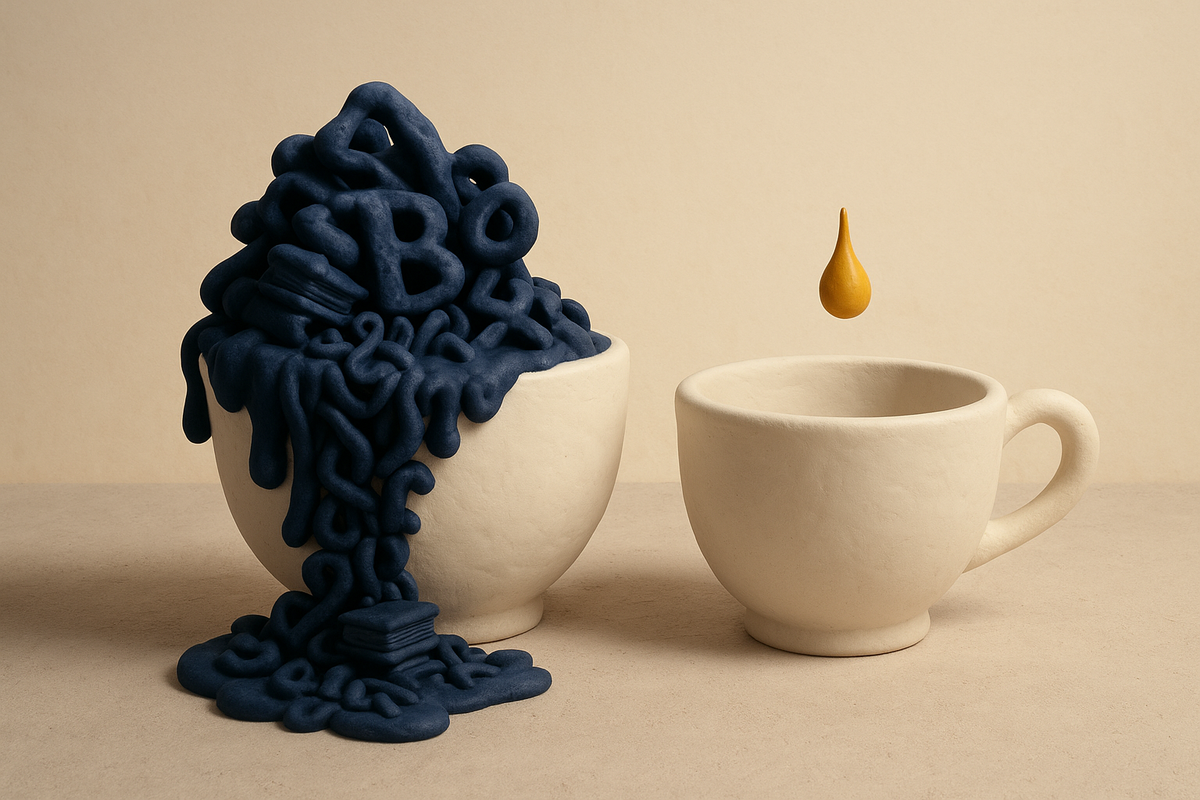
Nan-in served tea. He poured until the cup was full — and then kept pouring. Tea spilled over the rim, across the saucer, onto the table, down to the floor.
The professor watched, first puzzled, then alarmed. Finally he burst out: "Stop! It's overfull. No more will go in!"
"Like this cup," Nan-in said, "you are full of your own opinions and speculations. How can I show you Zen unless you first empty your cup?"
The lesson
Learning requires emptiness. A mind already packed with its own ideas has no room for a new one. The professor didn't fail because he was unintelligent — he failed because he was full. His knowledge, which had served him everywhere else, became the wall between him and the thing he came to learn.
This is the strange trap of expertise. The more you know, the more confidently you can pattern-match the new thing to something you already understand — and the pattern-match is exactly what stops you from seeing what's actually in front of you.
Why the full cup feels so good
Emptying your cup is hard, and it's worth being honest about why. A full cup is comfortable. It means you're competent. It means you have answers. It means you don't have to sit in the discomfort of not knowing — which, past a certain age and title, starts to feel like a kind of nakedness.
So we defend the cup. We do it in small, invisible ways:
- We finish people's sentences — filing their point under something we already believe before they've made it.
- We ask questions we already know the answer to — not to learn, but to confirm.
- We translate the new thing into old language — "oh, this is just X" — and lose everything that made it not-X.
- We collect opinions faster than we test them, mistaking a full cup for a wise one.
None of this looks like arrogance from the inside. It looks like efficiency. That's what makes it dangerous.
What emptying actually looks like
Emptying your cup doesn't mean forgetting what you know or pretending you're a beginner. That's false humility, and it's just as useless. It means holding your knowledge loosely enough that a new idea can sit next to it without being immediately crushed.
The practical version is smaller than it sounds. It's the pause before you respond. It's asking one more question instead of delivering your verdict. It's the willingness to say "I might be wrong about this" and mean it.
Notice the difference in posture:
| The full cup | The empty cup |
|---|---|
| "I already know how this works." | "How does this actually work?" |
| Listens to reply | Listens to understand |
| Defends the existing model | Tests the existing model |
| Seeks confirmation | Seeks surprise |
| Expertise as armor | Expertise as scaffolding |
The person with the empty cup isn't less knowledgeable. They're just not using their knowledge as a lid.
Rule of thumb: if you can predict what someone's going to say, you've stopped listening to them and started listening to your model of them.
Where this bites in modern life
The teacup story survives because the trap it describes never went away — it just changed clothes.
The senior engineer who dismisses the new framework because it looks like the last three. The founder who's heard so many pitches they can't hear a good one. The parent who already knows why their teenager is upset. The reader who's read so much about a topic that no single book can touch them anymore.
Each of them is holding a full cup and mistaking it for wisdom. And the higher you climb — the more books, the more years, the more wins — the fuller your cup gets by default, and the more deliberately you have to empty it.
The hardest part is that a full cup is invisible to its owner. You never feel closed off. You feel certain. Certainty is the sensation of a lid you can't see.
A small practice
Before your next hard conversation, meeting, or book, try one thing: assume the other side knows something you don't, and go looking for it. Not politely — genuinely. Ask what you'd have to believe for their view to make perfect sense.
You'll find that the moment you go hunting for what you're missing, the tea stops overflowing. There's suddenly room.
If this leaves you a little more room the next time you're certain you already know how something works, the Context Limit newsletter sends one idea at a time — slowly enough that the cup never overflows.