3 Stories to Read When You're Tempted
Temptation rarely shows up as a villain. It shows up as a reasonable-sounding voice. Three old stories for the moment you're about to give in.
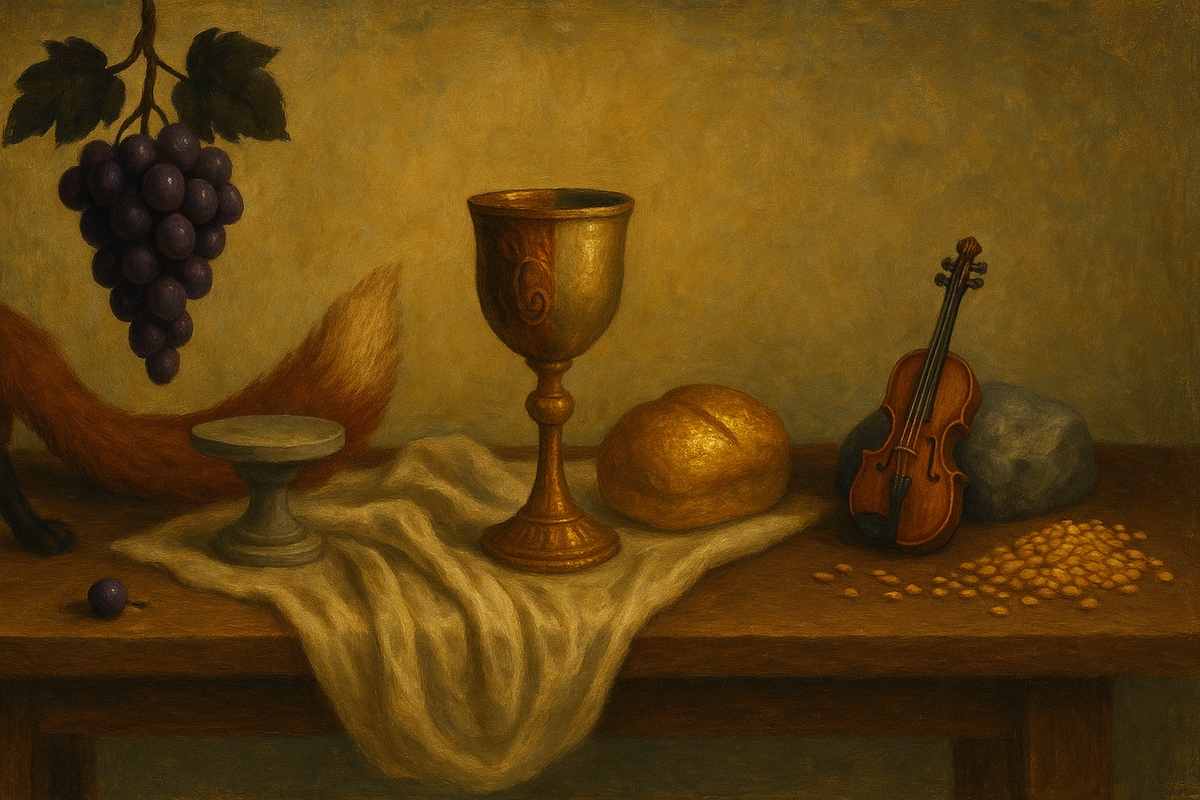
From Words: Fables, Parables, and Wisdom for Modern Life — 200+ wisdom stories, organized by the moment in life you'll need them.
Temptation almost never arrives as a villain. It arrives as a reasonable voice — the one that says you didn't really want that anyway, or this is the thing that will finally make you happy, or you can start tomorrow.
The oldest stories we have were built for exactly these moments. Not to scold you, but to hand you a small mirror right before you do the thing. Here are three, retold, for the next time you feel the pull.
1. The Fox and the Grapes — when you can't have it
A fox spots a cluster of grapes hanging from a high trellis. Plump, purple, glistening. He backs up, takes a run, and leaps. Misses. Leaps again, higher. Misses. Again and again, straining with everything he has, until he's exhausted and the grapes are still out of reach.
So he walks away. And as he goes, he glances back and mutters: "They were probably sour anyway. I didn't really want them."
Origin: One of Aesop's Greek fables, roughly 2,500 years old. It's where we get the phrase "sour grapes."
The lesson is quieter than it looks. The fox's real failure isn't the jump — it's the lie he tells on the way out. It's easy to despise what you couldn't get. But the moment you decide you never wanted it, you close the door on ever trying again.
Wanting something and failing to get it is honest. Pretending you never wanted it is the trap.
Temptation here is subtle: the temptation to protect your ego by shrinking your desire. It feels like relief. It's actually surrender dressed up as wisdom. The next time you catch yourself saying "I never cared about that anyway," ask whether that's true — or whether you just missed the jump.
2. King Midas and the Golden Touch — when you finally get it
King Midas was already rich. It wasn't enough. He dreamed of gold beyond counting. So when the god Dionysus offered him a single wish, he didn't hesitate: let everything I touch turn to gold.
Dionysus paused. "Are you certain?" Midas was certain.
At first it was ecstasy. Twigs, stones, columns, curtains — all gold at a touch. He danced through his palace laughing. Then he got hungry. The bread turned to metal in his hand. The wine hardened at his lips. When his daughter ran to comfort him, she froze mid-embrace into a cold golden statue.
Midas fell to his knees and begged for the curse to be lifted. Dionysus took pity and sent him to wash in the river Pactolus. The gold flowed out of him into the water. He rushed home, touched his daughter, and she woke — warm, alive. He gave away his wealth and lived simply for the rest of his days.
Origin: Greek myth, best known from Ovid's Metamorphoses. The river Pactolus really did run with gold flecks, which is where the story likely began.
Midas is the patron saint of getting exactly what you asked for. His temptation wasn't gold — it was the belief that more of the thing he already had would finally satisfy him. It never occurred to him that the wish had edges.
Rule of thumb: before you chase the thing you want most, ask what it would cost you to actually have it — completely, with no off switch.
Most modern temptations are Midas-shaped. The promotion that eats your evenings. The audience that turns every private thought into performance. The number that was supposed to be enough and then quietly wasn't. The wish isn't the danger. The unexamined wish is.
3. The Ant and the Grasshopper — when you'd rather not
All summer, the ant hauls grain from the fields to her home, storing it for winter. The grasshopper watches and laughs. "The sun is shining! Come sing with me." The ant says winter is coming and he should do the same. "Winter is far away," he says. "Today is for singing."
Autumn comes. His song gets quieter. Then winter — snow, bare fields, no food anywhere. The starving grasshopper crawls to the ant's door and begs. She looks at him and asks what he did all summer. "I was singing," he says. "Then dance now," she says. And she closes the door.
Origin: Aesop again. It's blunt even by fable standards.
The grasshopper's temptation is the most human of the three: the temptation to treat the future as someone else's problem. Not laziness, exactly — just the warm, reasonable certainty that there's still time.
Notice the shape of the lie: "Winter is far away." It's always far away, right up until it isn't. The cost of the easy choice is real, but it's deferred, so it doesn't feel like a cost at all.
Rule of thumb: do the boring thing while it's still optional, because by the time it's urgent, the door is closed.
Save something. Write the thing down. Have the hard conversation this week. Not because scarcity is coming to punish you, but because your future self is a real person, and right now you're the only one who can help them.
What the three have in common
Line them up and you get a small map of how temptation actually works — not as a single monster, but as three different voices for three different moments.
| Story | The moment | The tempting lie |
|---|---|---|
| The Fox and the Grapes | You couldn't have it | "I never wanted it anyway." |
| King Midas | You could have all of it | "More of this will finally be enough." |
| The Ant and the Grasshopper | You'd rather not deal with it | "There's still plenty of time." |
None of these voices sound like temptation. That's the whole point. They sound like common sense, like self-care, like patience. The work isn't resisting an obvious evil — it's recognizing a reasonable voice for what it is, in the two seconds before you agree with it.
You don't need to win every one of these. You just need to see them clearly. The fox who admits he wanted the grapes can try a different vineyard. Midas who questions the wish keeps his daughter. The grasshopper who stores a little grain gets to sing and survive.
Temptation loses most of its power the moment you can name it. These stories are just names, worn smooth by a few thousand years of use.
If you catch one of those reasonable-sounding voices in your own head this week — the one insisting you never wanted it anyway — the Context Limit newsletter sends along another name for that feeling now and then, quietly, no more than you can hold.